Back to Assignments

Assignment 1

Gesture, Contour & Observational Studies

Due: October 1st

Submit all Week 2 and Week 3 studies together as a single package.

Send your submission via email to mitchellh2@cnc.bc.ca. Please CC any other instructors for this course.

What to include

Your submission must include the drawings from the sessions and homework below.

Week 2 — In-Class Gesture Drawing Session
  • Figurines — gesture studies capturing weight, balance, and line of action
  • Live model charcoal contour drawings
Week 2 — Homework: Live Observational Drawing in the Field
  • A person waiting on or for a bus — 30, 60, and 90 second gesture drawings
  • A perching bird or sleeping cat — 30, 60, and 90 second gesture drawings
Week 3 — In-Class Drawing Session: Value, Texture & Space
  • Studies exploring value to describe the turning of forms
  • Texture and mark-making to communicate surface qualities
  • Space — using contrast, detail, and edges to build depth
Week 3 — Homework: Form, Texture & Space

Time: 30–45 minutes · Materials: Pencil + paper · Subject: 3 household objects

Choose three objects with different surface qualities and arrange them so they occupy foreground, middle ground, and background. Make one observational drawing that describes form, surface, and depth.

Choose three objects

  • Something smooth — mug, water bottle, spoon
  • Something rough — rock, shoe, cardboard
  • Something soft/textured — fabric, sweater, stuffed animal

Your drawing must use

  • Value to describe the turning of the forms
  • Texture/mark-making to communicate what the surfaces are made of
  • Contrast and detail to communicate spatial depth
  • Edges to help distinguish foreground from background

The challenge

  • You are not allowed to outline everything — make some edges appear through changes in value rather than line
  • Don't texture everything equally — the closest object should have more visible surface information, while distant objects can become simpler

Gallery — Student examples for inspiration

Notice how value, texture, and contrast are used to describe form and push objects into the distance. Do not copy these — arrange and draw your own objects.
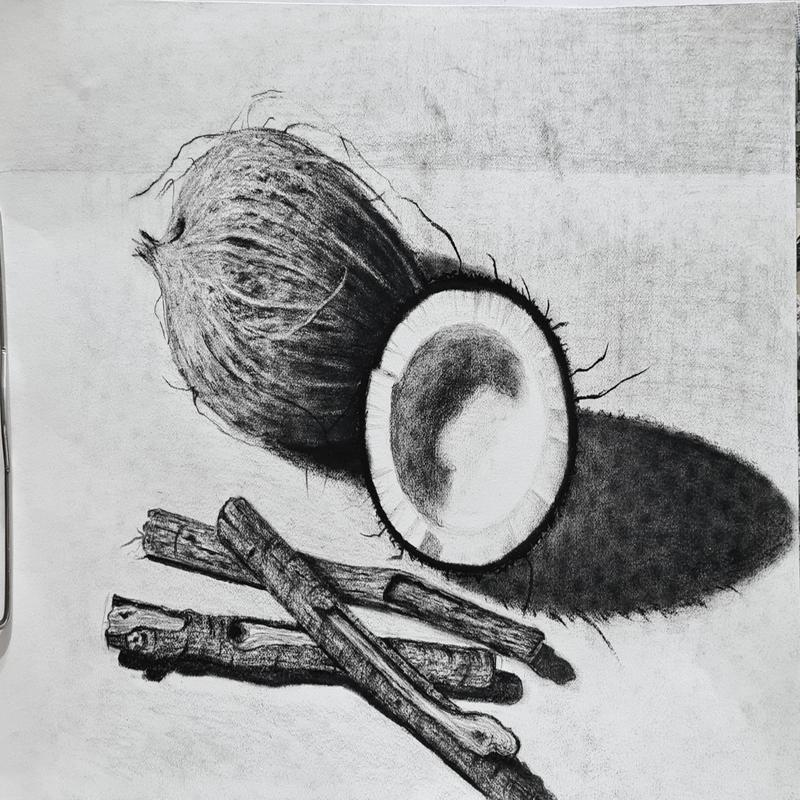
Charcoal still life of a whole coconut, a halved coconut showing its inner flesh, and wooden sticks with a strong cast shadow
Charcoal study — soft blended shadows and directional texture describe the rough coconut husk against the smooth inner flesh.
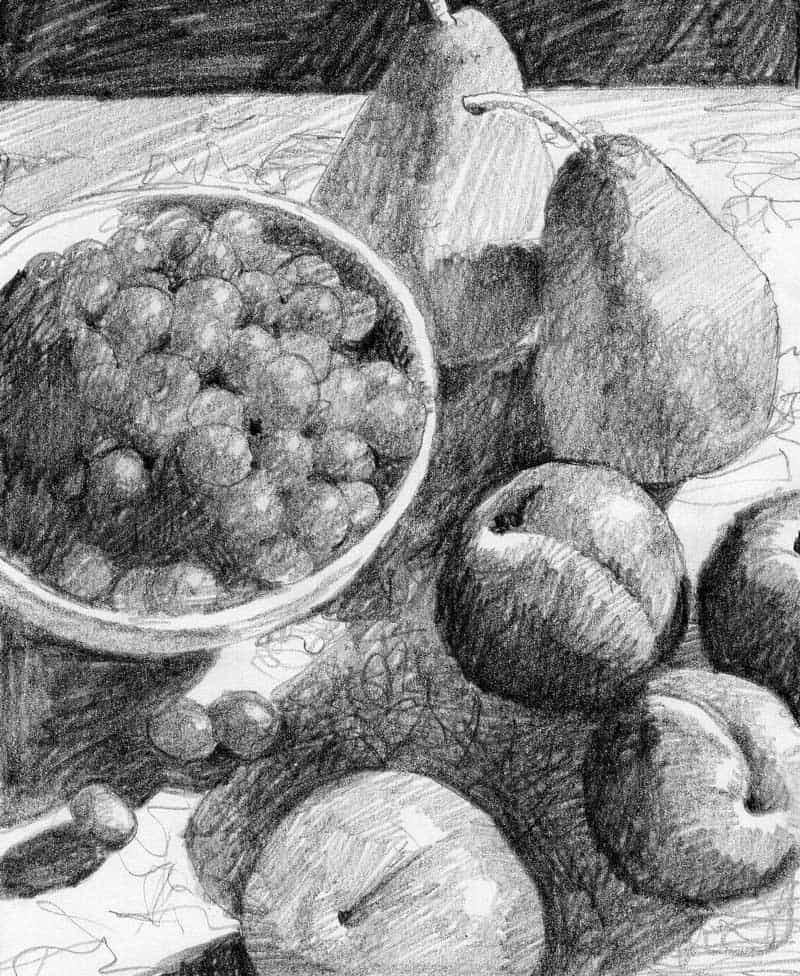
Graphite still life of a bowl of grapes with pears and apples on a table against a dark background
Graphite study — a dark background and higher contrast in front pull the foreground fruit forward while the bowl of grapes settles back.
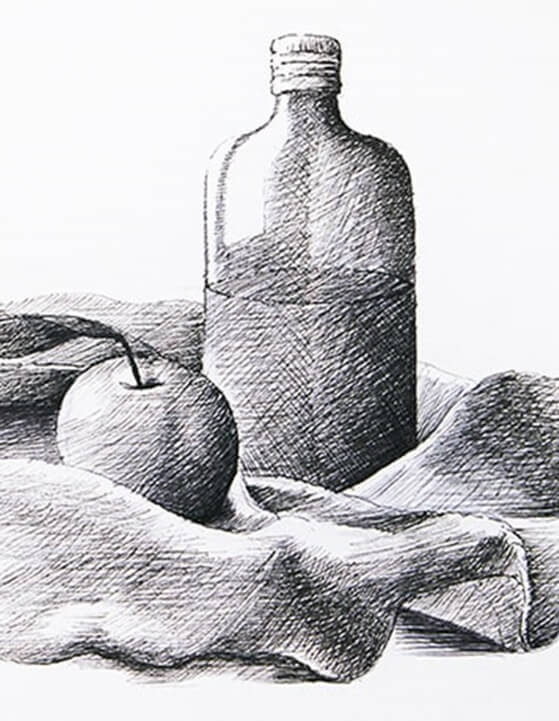
Pen-and-ink still life of a bottle and an apple resting on a draped cloth
Pen-and-ink study — layered crosshatching builds value and volume, turning line into the round form of the bottle and the folds of the cloth.
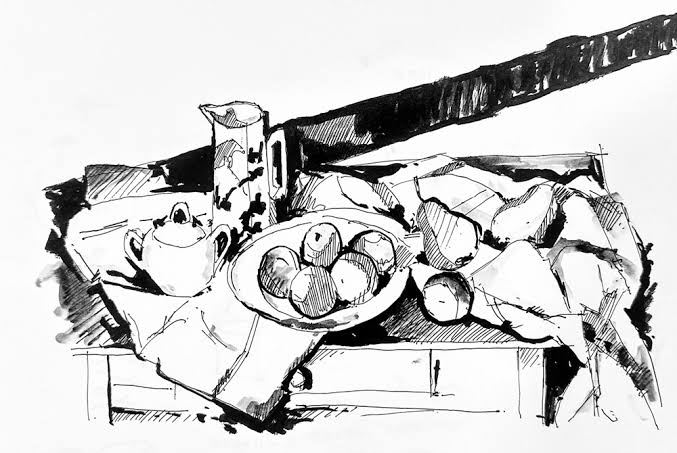
Loose ink and wash still life of a teapot, a bowl of fruit, and pears on a cloth
Ink-and-wash study — bold, loose marks and a strong dark background create dramatic contrast and a lively sense of light across the objects.
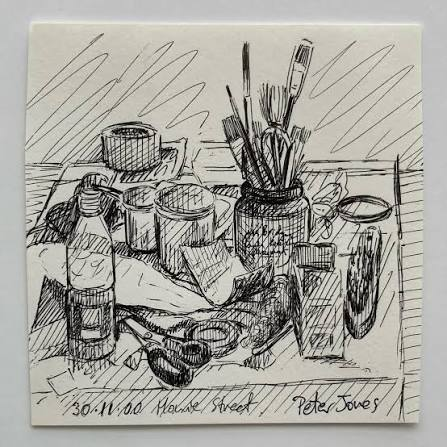
Pen-and-ink sketch of an artist's desk with jars, brushes in a jar, a bottle, and scissors
Pen-and-ink sketch — quick, energetic linework captures a cluttered desk of everyday objects, using overlap and hatching to suggest depth and grouping.
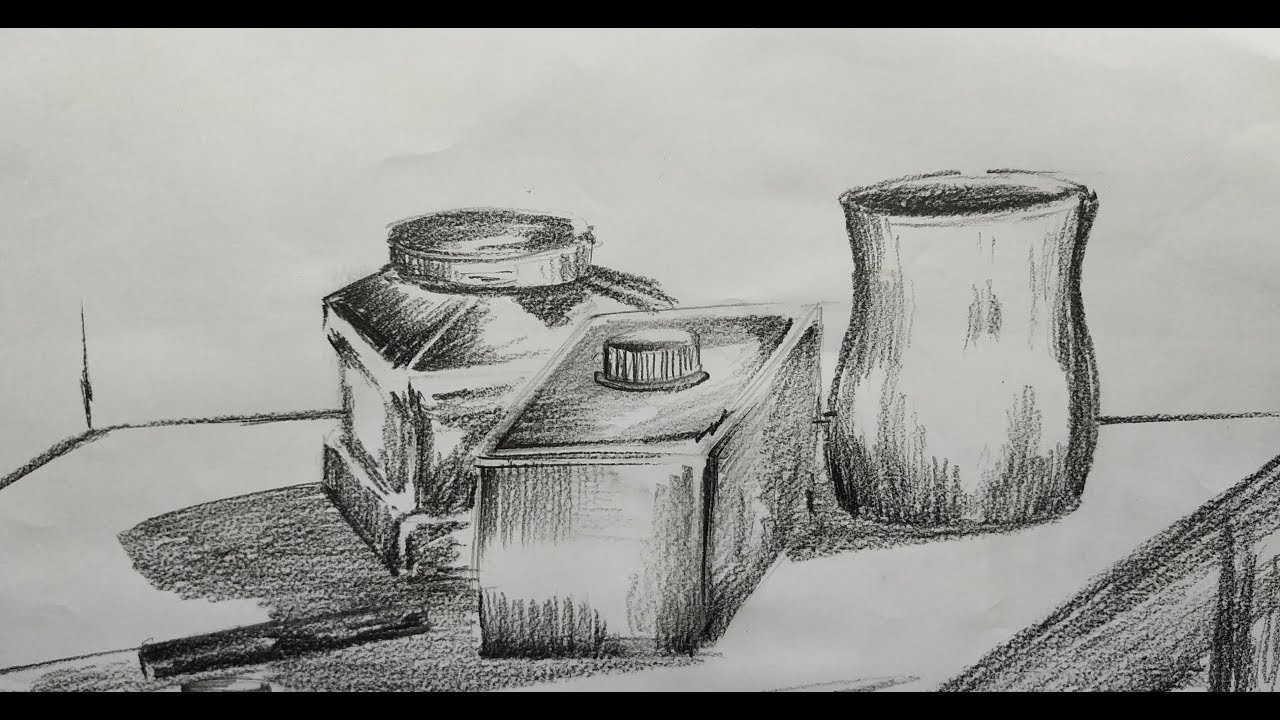
Graphite still life of two metal tins and a ceramic vessel with strong shadows
Graphite study — soft blended tones and firm cast shadows describe the weight and simple geometry of the tins and vessel on a plain surface.
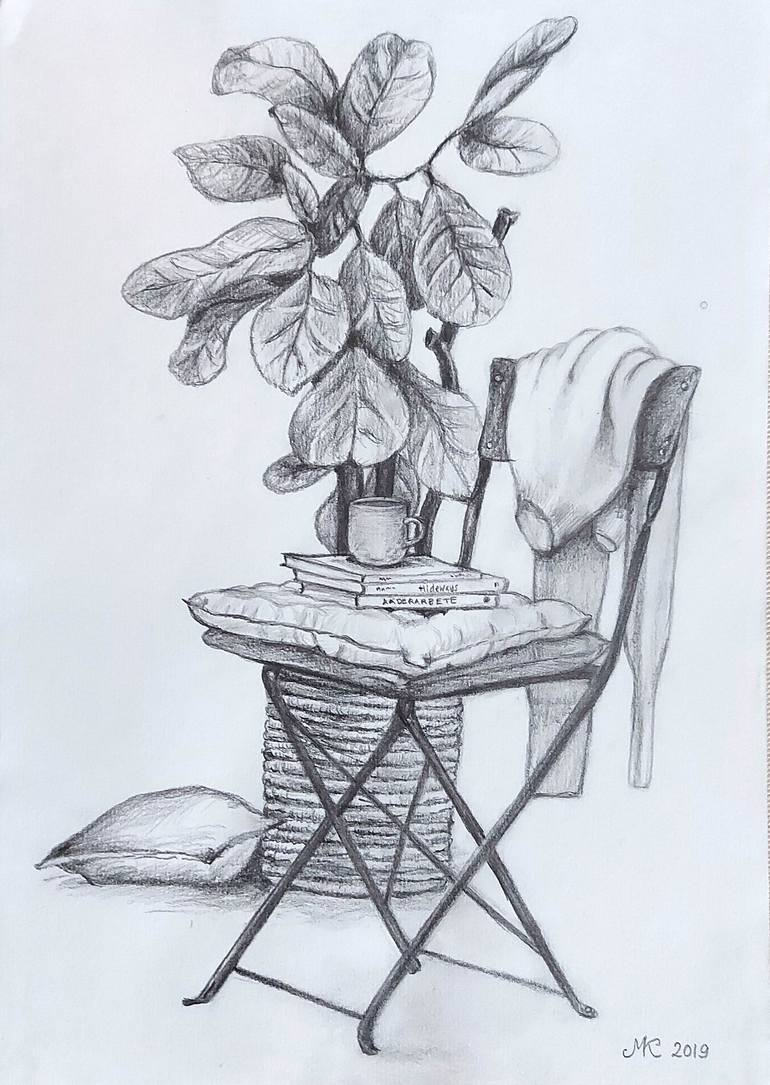
Pencil drawing of a potted leafy plant on a stack of books atop a folding bistro chair with a draped cloth
Pencil study — a more ambitious arrangement layers plant, books, cushion, and chair, using value and detail to lead the eye through a fuller still-life scene.